google.com, pub-0409865497112903, DIRECT, f08c47fec0942fa0
Finding something to celebrate, appreciate and be thankful for every...single... day !
Showing posts with label tutorial. Show all posts

Friday, April 3, 2015

Eagle Painting Tutorial with Sneetches on Beaches!


All too often I have seen artists that take themselves far too seriously. 

I imagine these people as Star-Bellied-Sneetches (by Dr. Seuss) with their Sneetch snoots pointed up in the air as they snort and guffaw at art or artists that they don't think are artsy fartsy enough, or whatever it is that snooty-snoots look down upon.

I'm not going to put either of us through any of that in this article. 

Sit back and relax -- let your guard down -- this is a pretension free zone where I am going share my mysterious, highly classified art secrets how I made some art stuff. 

This is a digital painting, and despite what some of the snooty-snoots whisper to one another at their exclusive star bellied parties, digital painting is every bit as valid an art form as traditional paint on canvas.

Some people seem to think that digital painting is manipulating a photo in some way -- or some sort of magical computer generated hocus pocus. It's not.

It is a nearly identical process to painting on canvas -- it is using the same skills that are developed over a lifetime of experience and practice. 

One great difference is that it's FREE! FREE canvas and FREE paint! Starving artists rejoice! We can finally paint whatever we want without plunking down 95 bucks for one measly itsy bitsy tube of Cobalt Blue!

Enough of my ranting -- on to the show!

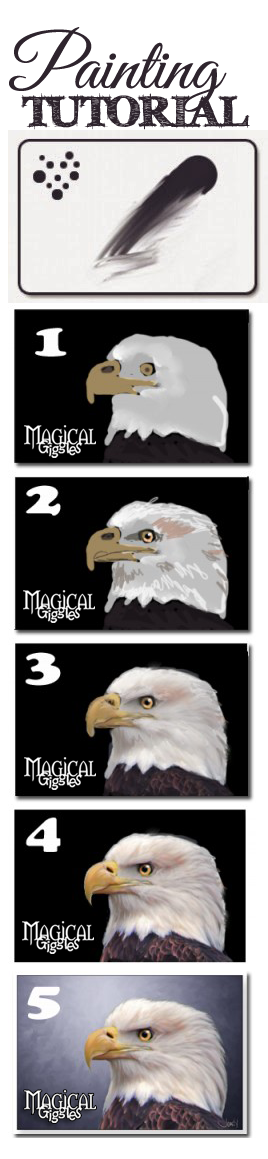
Before we start, lets look at the brushes I used for this painting. This is a digital painting, and the 'brushes' are just the shape of the pointy-thingy that you paint with.

I used the basic brushes. One with a hard edge and one with a soft edge (top picture).

The brush below that is the one I use for moving the 'wet' paint around and blending work (we'll get into that later).


1. On it's own layer (separate from the background) -- I drew the rough shapes. 

This is quick and rough and just for basic placement, but it really makes the painting take form right away.

Sometimes I practically close my eyes so that I am looking through my eyelashes -- this makes it impossible to see the details so it forces me to focus on basic shape and form without concerning myself with anything else -- it also lets me take a micro-nap so that I am well rested for the steps ahead (hardy-har-har).


2. More blocking in shapes, but a bit more refined, and bringing in more colors. 

When painting a living creature, I find it best to refine the eye as quickly as possible because that is the most important part of the face and it's a great anchor to work around. 

It also causes the subject to magically come to life just like placing the magician's top hat on Frosty the Snowman. Happy... Birthday!

This stage is bold and quick as well -- squiggly scribbles and bright un-blended color everywhere with a hard edged round brush.

3.Now it's time to do some real painting,blending, shaping and contouring using the paint laid on in the last step.

This stage is like gliding your paintbrush through the wet paint on a canvas.

I used the wet media blending brush (pictured below) for making soft wet painterly strokes (bye bye squiggly lines).

Here is an example of one stroke through solid color. 

See how it moves the color like gliding a paint brush through a blob of wet paint on the canvas? 

This is a wet media brush (on smudge) with strength set at about 50 percent.


4. Then back to the paint brush again, adding in more colors and washes of color while blending on the fly.

More and more refining, adding details, adding more color.

Back and forth painting and blending, over and over, adding color and working with the 'wet' paint.
5. Usually I am working on the background or at least laying down the main color for the background while I am painting on another layer. 

Unfortunately I did not capture that in these screen shots. 

I don't know why I thought the steps would be clearer for a tutorial with the background removed -- especially when the background color and the subject have to live together in the same space with the same light source.

So, contrary to the pictures, I do not recommend working on the background layer after the fact. It should be (and was) created hand in hand but on a separate layer.


Also, I do not recommend inviting a large bird of prey into your art studio, asking him to pose for a portrait and then foolishly slipping a bald joke into your polite banter. You can see in his eyes just how angry this made him. Stick to light conversation about the weather -- and jokes about ducks. Eagles LOVE duck jokes.

There is always lots of work(and fun!) in refining the details, painting and accentuating the light and shadows, adding unexpected pops of color.

This is truly the most satisfying part of the process for me.


Details like feather edges are a pleasure when working on a separate layer.

You can glide the brush through the 'wet' paint to create wispy feather shapes and edges, pushing and pulling the color without fear of ruining the background.


That about sums it up. 

This tutorial is just a basic overview of one process used by one artist on one painting.

Take this information for what it is worth. 

Please don't ever compare your art or your skill level to other artists, and don't ever let those with 'stars upon thars' make you feel like you are less than you are.


You are unique and beautiful. Put a piece of yourself on canvas and let it shine -- If all else fails just paint a star on your belly.

And now for some shameless self promotion!

If you'd like to own a print of this eagle painting, or you'd like this image on a mouse pad, postage stamps, collector plate, mug or tons of other awesome and easily customized goodies, click the links below for my Fine Art America page as well as my Zazzle shop.

Thanks for stopping by, and have a GREAT Day!


Sell Art Online


Sunday, February 8, 2015

Spinach


Fun Fact: If you saute' spinach with Olive Oil, Popeye will show up at your front door! It's a Fact! (just cooking spinach alone won't do it - it's Olive Oil that brings his two great loves together)

So, let's saute' some spinach!

Why? Because it is yummy and healthy and easy to make! Step by step guide below.

Plus, even if you eat the entire bag of spinach yourself, it's only 50 calories! - for the WHOLE bag!

Personally I prefer steamed Kale, and actually love it so much I feel the guilt of having binged on something sinful when I eat it!

If you prefer spinach to kale, try it this way. Peggo swears that this is one of the tastiest ways to cook it - second only to cooking hamburgers in a pan, removing the cooked hamburgers and then tossing the spinach into the pan and sauteing in the hamburger juices instead of olive oil.

Step 1:Buy some yummy fresh spinach. We bought this bag at Aldi for only $1.79.


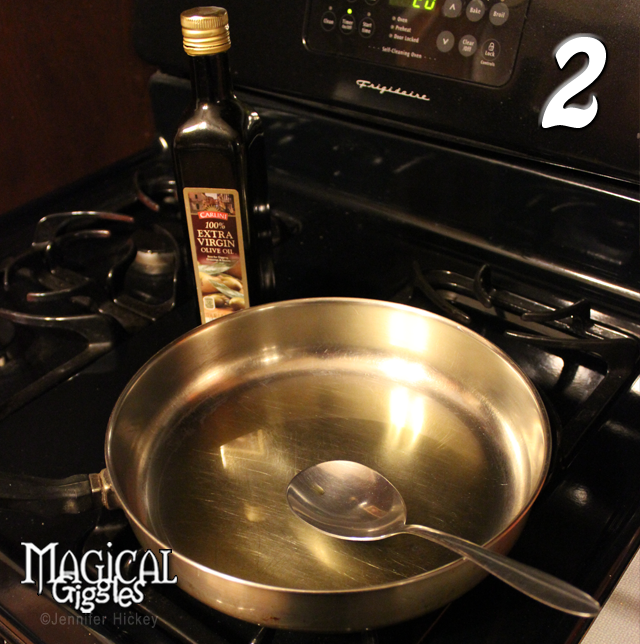
Step 2: Heat up some Extra Virgin Olive Oil in a pan, just enough to cover the bottom so that the leaves don't stick.
Step 3: Toss the spinach in the pan and quickly get it moving around - it cooks FAST.

Step 4: Keep it moving until it looks like this, and serve immediately. YUM! 

Even if you eat it slathered in butter, it's still a low calorie and healthy treat!
Here it is plated and ready to eat. Yum! 

Wednesday, December 17, 2014

How to Remove Staples from Hardwood Floors

How to remove staples from Hardwood Floors!


I've done lots of home improvement projects, but only on a beginner level, so I still have a TON of things to learn and re-learn with each new project.

With this flooring project I knew how to remove the plywood sub-floor and linoleum, but I did not consciously anticipate the sub-floor leaving behind what felt like billions of staples that did not come up with the plywood.

My first instinct was to pull the staples with the tools I had with me, which were just screwdrivers and a pair of regular non-locking pliers.

Both tools were painfully inadequate and the very first wave of regret and panic washed over me as I looked out at what seemed to be an army of tiny little staples marching in formation as far as the eye could see -- threatening to destroy all home improvement dreams.

I thought I was being logical when I figured that I could yank each staple out at the angle they were put in - straight up and out - using brute force. 

I dont know why I thought this. That certainly isnt how I would try to pull a nail! 

It just goes to show you that fear (that I was in over my head with this project) can make you forget things you already know, and make illogical thoughts seem right!

Then we remembered that locking pliers exist, and are a far better fit than the non-locking ones I tried, that left my hand aching and exhausted after only a few staples. 

So, to pass on the knowledge, and to remind myself for any future projects, here is how I did it.

Step 1: Look at all the staples and freak out as you realize that you are about to spend a huge portion of your life on the floor, crushing the flesh between your knee bones and the floor (or you can do as I did and do the majority of the work sort of lying on the ground like a sea lion). 

I'd say this staple pulling extravaganza was a combined total of about 4 hours of lying on the ground with non-stop staple pulling fun, and by the end of it I was feeling a distinct urge to clap my flippers and beg someone to toss me a fish.

Or you could wear knee pads.


Step 2: Find those locking pliers and lock them down on a staple. You will probably have to adjust them so that they grip tightly enough to pull the staple, but not so tightly that locking and unlocking the pliers is painfully difficult. 


Step 3: Once locked on, just tip the pliers to the side and follow the curve of the tool, slowly rolling the tool on the floor and letting it do all the work of prying the staple out. 

The staple will start to pull up and will bend a bit as it comes up. Take it slow, because some staples are in there better than others, and some pull out easier than others. 

I can't tell you how many times a staple came out slowly with a lot of resistance and then suddenly no resistance causing me to crush my poor thumb against the ground with the tool. OUCH!

Step 4: The staple comes out and you realize it was pretty easy and you only have to do it a billion more times!

Now, maybe I get a bit loopy when I do a tedious and monotonous task, but take a look at those pictures and tell me you don't see a face on the locking pliers! 

It looks like a prehistoric staple eating creature! I love him and want to keep him as a pet and name him!

I wish I could report that I gave the staple eating creature a creative name befitting his prehistoric and slightly amphibian countenance, but I didn't. I named him "Facey" -- because he has a face, and I am a doofus.

This is really all the proof I need to know for certain that I spent too many hours in solitude on that floor with the staples, and that it may have caused my brain to transform into a bowl of oatmeal. 

Okay, that is the end of my big 'how to pull a staple out of wood" tutorial.

Though I suppose all of this article could have been summarized by saying;   

"Pull staples from wood using locking pliers. The End."  

...but that wouldnt be nearly as much fun as describing myself as a sea lion, a doofus, an oatmeal brain and someone who names her tools and thinks that they are prehistoric amphibians that eat staples.